
Disguised Alpha   /   Compound references. Original research.
SLU-PP-915Research reference

Small molecule / ERR signaling

SLU-PP-915A closer look at ERR biology.

SLU-PP-915 is an experimental small molecule that activates all three estrogen-related receptor subtypes. It is chemically distinct from SLU-PP-332, despite their shared target family. Researchers have studied its chemical design, gene-expression effects, cellular recycling pathways, and mouse exercise capacity. A later mouse study demonstrated oral activity under its experimental conditions. None of these findings establishes efficacy or safety in people.

Preclinical research

A focused reference from the Disguised Alpha research network.

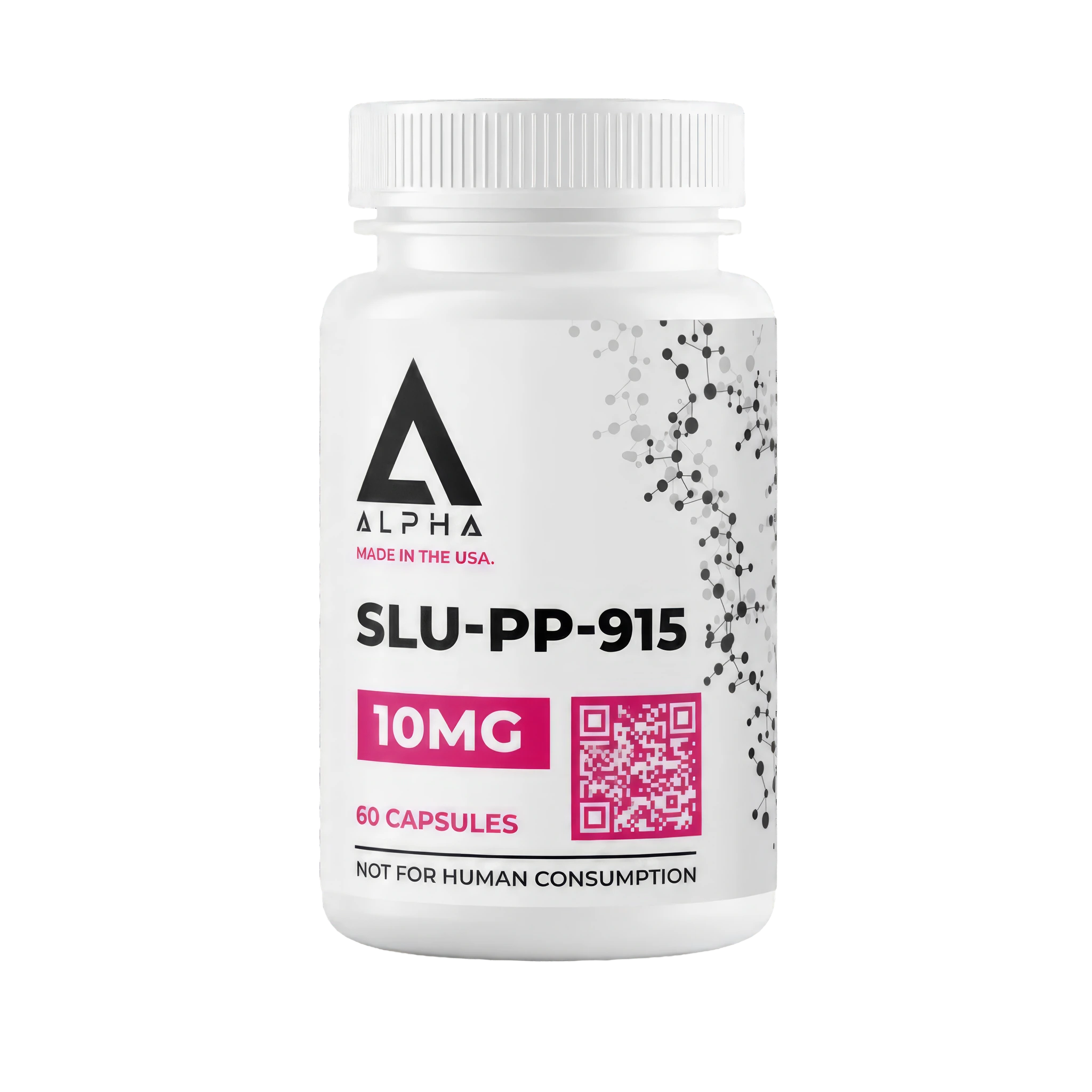
Disguised Alpha SLU-PP-915 product reference image
SLU-PP-915Catalog imagery · RUO
Molecular formula
C₁₇H₁₃BFNO₃S
Molecular weight
341.2 g/mol
PubChem CID
142532359

Disguised Alpha catalog

Find the matching product.

Open the exact product listing for its format and documentation. Published studies do not validate a supplier’s finished product.

01 / The science

Understand the research focus.

A clear starting point for the mechanisms, experimental models and questions behind the compound.

01

A distinct chemical scaffold

The discovery program developed a thiophene-based series and identified SLU-PP-915 as a boronic-acid-containing pan-ERR agonist. Binding and cell assays supported activity at the receptor family. Chemical changes can affect exposure and metabolism, so similar target activity does not make two compounds interchangeable.

Read the primary source ↗
02

Exercise-related transcription

Mouse experiments measured running capacity alongside expression of Ddit4 and mitochondrial genes. A 2026 report explored oral administration and interaction with exercise training. These linked measurements help researchers examine a biological hypothesis, while remaining distinct from clinical evidence of improved fitness or disease treatment.

Read the primary source ↗
03

Autophagy and TFEB

Cell experiments examined TFEB, a regulator of the autophagy-lysosome pathway. ERR activation increased TFEB expression and related gene programs in cardiac and muscle-cell preparations. This identifies a pathway for further study; increased expression in cells is not proof of enhanced longevity or whole-body cellular repair.

Read the primary source ↗

02 / Read with context

Know what the evidence can tell you.

The selected evidence comes from laboratory and animal studies. It does not establish human efficacy, an appropriate human-use protocol, or the safety and performance of a commercial formulation. SLU-PP-332 and SLU-PP-915 are distinct molecules and should not be treated as interchangeable.

Start with three questions.
01What was tested?
Check the exact molecule, sequence, composition and formulation.
02Where was it tested?
Cells, animals and clinical populations answer different questions.
03What was measured?
A pathway signal is different from a demonstrated clinical outcome.

03 / Selected publications

Go straight to the source.

Original records, study models and the limits that matter when interpreting a result.

STUDY 01 · 2023
Chemical series, receptor assays, muscle cells, and mice

Development and pharmacological evaluation of a new chemical series of potent pan-ERR agonists, identification of SLU-PP-915

The study identified SLU-PP-915 and connected its receptor activity to changes in ERR target-gene expression. It also examined metabolic stability during chemical optimization.

Reading limit: This is early pharmacology and compound development. It does not establish clinical effectiveness, a human exposure target, or long-term safety.

↗
STUDY 02 · 2026
Mice; exercise and gene-expression experiments

An orally active estrogen receptor-related receptor agonist, SLU-PP-915, enhances aerobic exercise capacity

Investigators reported increased treadmill performance with oral SLU-PP-915 and compared responses with SLU-PP-332 after accounting for systemic exposure. They also examined gene-expression changes alongside exercise training.

Reading limit: Oral activity in mice is not a demonstration of human oral effectiveness or equivalence with a particular capsule product.

↗
STUDY 03 · 2024
Neonatal rat ventricular myocytes and mouse muscle-cell line

The Estrogen Receptor-Related Orphan Receptors Regulate Autophagy through TFEB

The researchers identified TFEB as a direct ERR-regulated gene and found increased TFEB-related expression after ERR activation. SLU-PP-915 was used to investigate this connection in cell preparations.

Reading limit: Cellular pathway measurements do not establish clinical rejuvenation, disease prevention, or a lifespan effect.

↗

A focused selection, not a systematic review. Studies concern the tested material and do not validate a supplier’s finished product.

Explore research & source notes →

04 / Common questions

A little more clarity.

Quick answers for reading the science behind SLU-PP-915.

Is SLU-PP-915 the same as SLU-PP-332?

No. They share ERR activity but have different structures. Their experimental exposure profiles also differ. A result for one compound should be attributed to that compound and its tested conditions.

Has oral activity been reported?

Yes, in mice in the cited 2026 study. Oral activity describes an experimental finding; it does not establish a human regimen or certify that a commercial preparation matches the research material.

Does autophagy research establish anti-aging effects?

No. TFEB expression and related cellular measurements are mechanistic endpoints. They should not be converted into claims about longevity, rejuvenation, or protection from disease without appropriate outcome studies.

What other research questions are being explored?

A separate mouse pressure-overload study examined ERR agonists, including SLU-PP-915, in cardiac dysfunction. Such work broadens the experimental questions but remains animal-model evidence, not a demonstrated treatment for human heart failure.

Continue your research

One compound. A wider research library.

Explore the complete SLU-PP-915 profile and related compounds in the Disguised Peptides research hub.

Open the full profile ↗